FMCSA Tightens Cargo Securement & Axle Weight Enforcement for Specialized Hauling
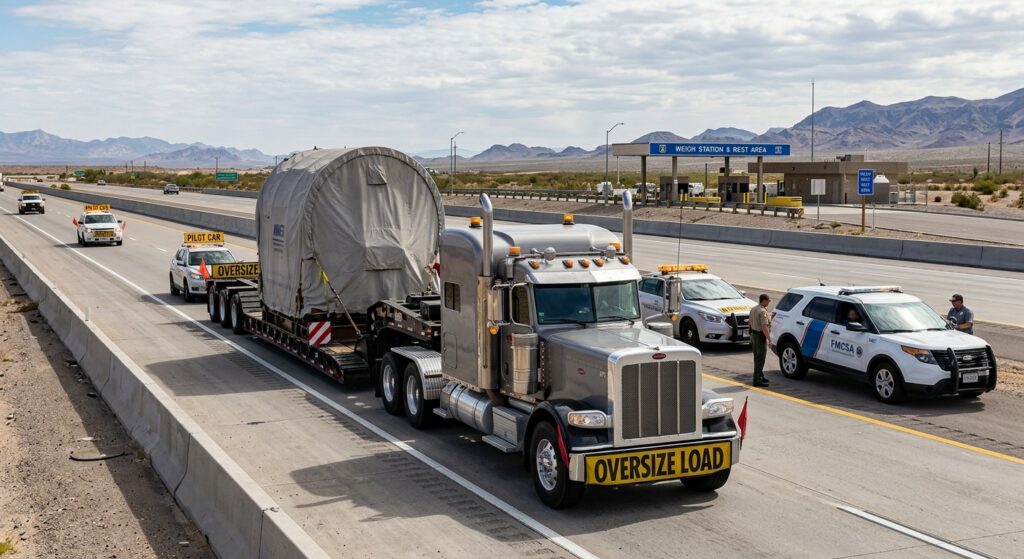
The Federal Motor Carrier Safety Administration (FMCSA) in coordination with the Commercial Vehicle Safety Alliance (CVSA) has increased targeted roadside inspections for heavy haul combinations. Enforcement officers are focusing heavily on Working Load Limits (WLL) for chain securement, secondary attachment tie-downs for heavy equipment (excavators, bulldozers, cranes), and precise axle-weight distribution across multi-axle RGN and lowboy setups.
- Key Highlights:
- Strict verification of tie-down points, chain grades, and binder tensioning for equipment over 10,000 lbs.
- Automated weigh-in-motion (WIM) systems flagging unpermitted overweight axles on state highways and bridges.
- Shipper Impact: Partnering with experienced heavy haul carriers guarantees exact weight calculations and route compliance, preventing costly scale house detentions or out-of-service violations.
2. August | State DOTs Harmonize Permitting Standards & Pilot Car Certification Requirements
Category: Permits & Oversize Logistics
Several state Departments of Transportation (DOTs) are implementing unified escort vehicle (Pilot Car) standards for superloads and extreme oversize freight. The updated guidelines enforce standardized two-way radio communications, certified escort driver training credentials, and uniform amber lighting and flag placements for night transit.
- Key Highlights:
- Faster interstate permit approval turnarounds due to synchronized route requirements between neighboring states.
- Mandatory pre-route surveys for loads exceeding standard clearance heights (13′ 6″ to 14′) or extreme widths.
- Proactive Strategy: Engage dispatch teams early to map out route surveys and lock in certified pilot car escorts prior to pickup.
3. September | FMCSA Escalates Fight Against Freight Fraud with Enhanced Identity Verification
Category: Compliance & Security
To combat double-brokering and identity theft within specialized transportation, the FMCSA has upgraded its digital registration portal with multi-factor authentication for USDOT and MC authority holders. This initiative ensures high-value freightsuch as industrial generators, transformers, and mining gearis handled strictly by legitimate, vetted entities.
- Key Highlights:
- Real-time verification of active $1,000,000+ cargo insurance policies prior to load assignment.
- Enhanced transparency between shippers, licensed property brokers, and boots-on-the-ground motor carriers.
- The Heavy Haul Group Advantage: Full peace of mind knowing every dispatched load is backed by verified DOT authority and active $1M cargo coverage.
4. September | Nearshoring Surge Prompts Updated Cross-Border Heavy Haul Protocols
Category: International & Cross-Border Logistics
The ongoing boom in manufacturing nearshoring has driven record volumes of heavy machinery and plant equipment across the U.S.–Mexico and U.S.–Canada borders. In response, border transportation authorities have streamlined inspection procedures for specialized heavy equipment trailers moving through key trade corridors in Texas, Arizona, California, and northern ports.
- Key Highlights:
- Accelerated border processing for agricultural and construction machinery with pre-cleared customs documentation.
- Specialized cross-border driver coordination to eliminate drop-and-hook delays at international customs yards.
- Operational Edge: Seamless, end-to-end cross-border transport management without freight hand-off complications.
5. September | Updated FMCSA Guidance on Hours of Service (HOS) Exemptions for Emergency & Indivisible Loads
Category: Regulations & Catastrophic Recovery
The FMCSA released updated regulatory guidance clarifying Hours of Service (HOS) relief and Electronic Logging Device (ELD) rules for carriers hauling indivisible superloads engaged in emergency response and critical infrastructure recovery.
- Key Highlights:
- Clear definition of allowable movement windows for emergency equipment mobilization following natural disasters.
- Special logging protocols for low-speed, multi-axle superload moves on public highways.
- Logistics Value: Enables dispatch teams to rapidly deploy emergency heavy haul equipment (Catastrophic Recovery) while remaining 100% compliant with federal safety directives.
Source: https://cvsa.org/programs/international-roadcheck/focus-area/